
Lake Hartwell history runs deeper than the shoreline: the Anderson SC farms, roads and river valley homes that vanished when the reservoir quietly filled.
Stand at the edge of the water on a cool October morning in Anderson County and it is easy to assume Lake Hartwell has always been here. The coves look permanent. The pines come right down to the red clay bank. Boats idle out past the points while the hardwoods on the far shore turn copper and rust. But Lake Hartwell history is younger than the oaks shading some of Anderson's older streets, and everything under that water used to be something else entirely. Fields. Creek bottoms. Wagon roads and farm lanes. Houses with porches and pump houses and barns that smelled like hay and motor oil.
With roughly 962 miles of shoreline shared between South Carolina and Georgia, Lake Hartwell is big enough to feel like geography rather than engineering. It is both. And for the families whose land became lakebed, the story is not an abstraction about reservoirs and watersheds. It is the story of packing up a life on somebody else's timeline. That part of our local history deserves telling, especially in the season when the lake is at its prettiest and most crowded.
The land that became Lake Hartwell was river country before it was lake country. Narrow, winding water cut through steep clay banks, with bottomland on either side that farmers prized because the soil was deep and forgiving. Up on the ridges, the ground was harder work — thin, orange, and full of rock. Down in the bottoms, corn grew tall.
Life in that valley was organized around the river rather than the highway. Roads dipped down to crossings and came back up the other side. Mills sat where the water fell fast enough to turn a wheel. Family cemeteries occupied the high ground because everyone understood what a river could do in a wet spring. Neighbors were the people within a wagon ride, and a crossroads with a store and a few houses served as the center of a world that did not extend much past the next county.
This was Anderson County before the Electric City became a textile hub, and it stayed rural long after our mills were humming and our streetlights were the talk of the Southeast. While downtown Anderson filled with commerce and brick storefronts around the county courthouse, the river districts kept farming. Cotton, corn, hay, cattle, hogs, a garden big enough to can from. Many families had worked the same acreage for generations, and the land itself was the inheritance — not a bank account, not a portfolio, but a particular bend of creek and a particular stand of trees that your grandfather had cleared.
That is the part modern visitors can't see from a pontoon boat. The lake did not fill empty land. It filled occupied land, and the occupation was deep and old.
Reservoir projects changed the map of the Southeast, and the one that created Lake Hartwell changed ours. Whatever the reasoning recorded in the project files, the effect on this corner of Anderson County was total. A river became a lake, and a landscape measured in fields and fence rows became a landscape measured in coves and points.
The physical process of building a reservoir is not glamorous. Before the water rises, the valley has to be cleared and surveyed. Timber comes out. Structures come down or get moved. Roads are rerouted, bridges rebuilt, utility lines relocated. Land gets appraised, bought, and taken out of private hands. And then, slowly, the water arrives — not as a wave but as a creeping, patient thing that fills the lowest ground first, then the next lowest, until the creeks you used to step across are bays with names.
What makes Lake Hartwell formation so interesting from an Anderson perspective is how completely the new shape took over. The lake became the organizing fact of western Anderson County. Our recreation, our real estate, our tourism, our fishing, our weekend habits — all of it reoriented around water that had not existed in an earlier generation's childhood. Visitors who come over from Clemson, a short drive up the road, treat the lake as a permanent feature of the landscape, the way they treat the hills. Only the people who remember the valley know how recent the whole arrangement is.
That is worth sitting with for a minute. Most places are reshaped slowly, by weather and commerce and a hundred small decisions. This one was reshaped on purpose, within a span a person could live through, and the before-and-after is as clean a line as local history ever draws.
"Lost towns" is the phrase people use, and it captures something true even if the reality was usually smaller and more scattered than the phrase suggests. Most of what went under was not a town with a main street. It was the fabric that holds rural places together: farmsteads, tenant houses, barns, smokehouses, well pumps, crossroads stores, schoolhouses, mill sites, bridges, and the roadbeds that connected them all. Take away the roads and the crossings and a community dissolves even where the houses survive, because the connections are gone.
Family cemeteries were a particular heartbreak, and reservoir projects across the region handled them the same way: identify, document, and relocate. It is an orderly administrative process on paper. For a family, it means watching your people moved twice — once into the ground and once out of it.
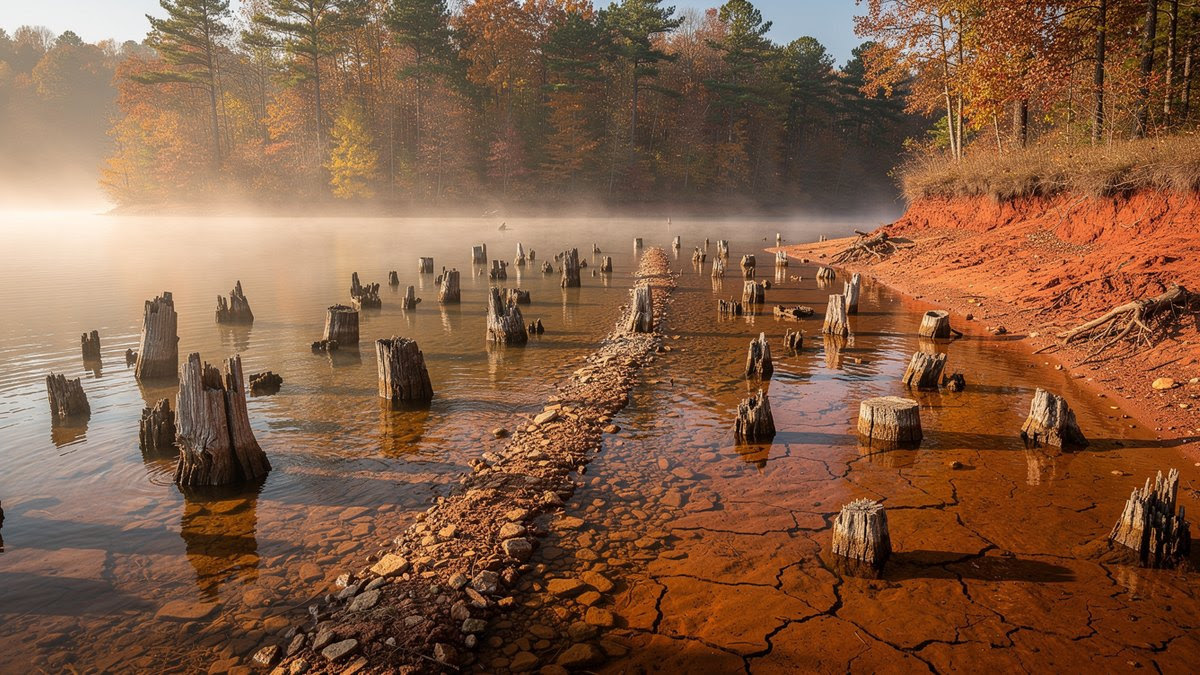
Some structures were demolished. Some were bought and hauled off by whoever could use the lumber. A few houses were jacked up and relocated to higher ground, where they still stand, looking slightly out of place in a yard that was never meant to hold them. And a great deal simply stayed where it was and went under, which is why anglers who know the lake know exactly where to find a drowned roadbed, an old foundation line, a fence row, or a stand of stumps that marks the edge of a field nobody has plowed in a very long time. Structure attracts fish. The best underwater cover on Lake Hartwell is often somebody's former front yard.
The human arithmetic was harder than the engineering arithmetic. If your family had farmed the same bottomland for generations, no payment made the ledger balance. You could buy acreage somewhere else. You could not buy back the spring your mother carried water from or the pecan tree your father planted the year you were born. Anderson SC reservoir history is full of people who accepted the inevitable, did the paperwork, loaded the truck, and never quite got over it.
Here is the detail that strikes us most, working in self storage on Bleckley Street: those families had almost nowhere to put their things. When you have to be off your land by a certain date, you are not just moving furniture. You are moving three generations of accumulation — the dining table that came from a grandmother, the quilts, the photographs, the farm tools, the tractor and the implements, the canning jars, the scrap lumber too good to burn. If the next house is smaller, or if there is no next house yet, something has to give. Decisions got made in a hurry that could never be unmade. Plenty of Anderson County heirlooms ended up in a leaky barn, in a relative's shed, at a sale, or on a burn pile, not because anyone wanted that but because there was no in-between place to set things down while the family figured out the rest.
That in-between place is exactly what a storage unit is. When an Anderson family today sells a house before the next one closes, downsizes a parent's home, renovates a kitchen, blends two households, or sends a student off to Anderson University or Clemson, the hardest part is rarely the big stuff. It is the pressure to decide fast. A 10x10 unit at $75 a month holds the contents of several rooms and buys you the one thing those displaced families never had: time. A 10x20 at $120 handles a whole household, furniture and all, with room to walk between the stacks. Our first month is free with a refundable deposit, access is available 24/7, and the property is under 24/7 security surveillance, so you are not driving across town at 3 a.m. wondering whether the door you locked is still locked. Breathing room is a small thing to offer and a surprisingly large thing to have.
Autumn is the right season to go looking for the old valley. The hardwoods along the shoreline turn, the humidity finally breaks, the summer boat traffic thins out, and the water often sits lower than it does in spring. Low water is the storyteller. As the lake drops, it gives back the edges of what it covered: stump fields that mark former timber and cleared ground, stone and concrete footings, rock piles that were once a fence line or a chimney, and the occasional stripe of old roadbed running straight into the water and out the other side of a cove.
A few ways to read the landscape while you are out there:
Green Pond Landing is a straightforward place to put a boat in and get out onto Anderson County water, and the drive out there through the western part of the county is worth the trip by itself in late October. If you'd rather stay dry, the shoreline parks and roadside overlooks between Anderson and the Pendleton area give you the same long views of water filling valleys that used to be farms. Fall weekends bring plenty of visitors to these same shores, and if you happen to be showing folks around, the lost-towns story turns a pretty view into a memorable one.
The Electric City has never been shy about change. We wired our streets early, built mills, watched them close, and repurposed the buildings. Lake Hartwell belongs on that same list — a deliberate remaking of the county that gave us enormous benefits and asked a specific group of families to pay for them.
If your own family is facing a transition this fall — a move, a downsize, a renovation, a house full of things that need somewhere safe to wait — we'd be glad to help you find the room. Bleckley Street Self Storage offers 10x10 units at $75 a month and 10x20 units at $120, with your first month free when you put down a refundable deposit, 24/7 access, and 24/7 security surveillance. Call us at (864) 351-4023 or come see the place at 401 Bleckley St, Anderson, SC 29625. Nobody should have to make permanent decisions about a lifetime of belongings on a deadline.
Frequently asked questions |
Are there really lost towns under Lake Hartwell? Most of what the lake covered was rural rather than urban — farmsteads, tenant houses, barns, schoolhouses, crossroads stores, mill sites, bridges, and the roads connecting them. "Lost towns" captures the feeling accurately even though the reality was usually a scattered farming community rather than a main street. When roads, crossings, and homeplaces go under, the community disappears even where a few houses survived by being moved to higher ground. |
How big is Lake Hartwell? Lake Hartwell is shared between South Carolina and Georgia and has roughly 962 miles of shoreline, a large share of it along Anderson County. That crooked, deeply indented shoreline is why so much of western Anderson County sits within a short drive of the water, and why the lake feels more like geography than like a built structure. |
Can you still see old foundations and roads in Lake Hartwell? Yes, especially when water levels are low. As the lake drops, stump fields, concrete and stone footings, rock piles from old fence lines and chimneys, and stretches of old roadbed running into coves become visible along the shoreline. Fall is often a good time to look, since levels tend to sit lower and the shoreline hardwoods make the trip worthwhile on their own. |
What size storage unit do I need when I'm between houses in Anderson SC? A 10x10 unit at $75 a month holds the contents of several rooms, which covers most short-term gaps, renovations, or downsizing projects. A 10x20 at $120 a month handles a full household including furniture, with room to walk between stacks. Bleckley Street Self Storage includes your first month free with a refundable deposit, plus 24/7 access and 24/7 security surveillance. |
How does self storage help during a move or a downsizing? It removes the deadline pressure. Instead of deciding in one weekend what to keep, sell, or give away, you can move everything into a unit and sort it over weeks instead of hours. That matters most with family furniture, photographs, and heirlooms, which are exactly the things people regret rushing. You can reach us at (864) 351-4023 or stop by 401 Bleckley St, Anderson, SC 29625. |