
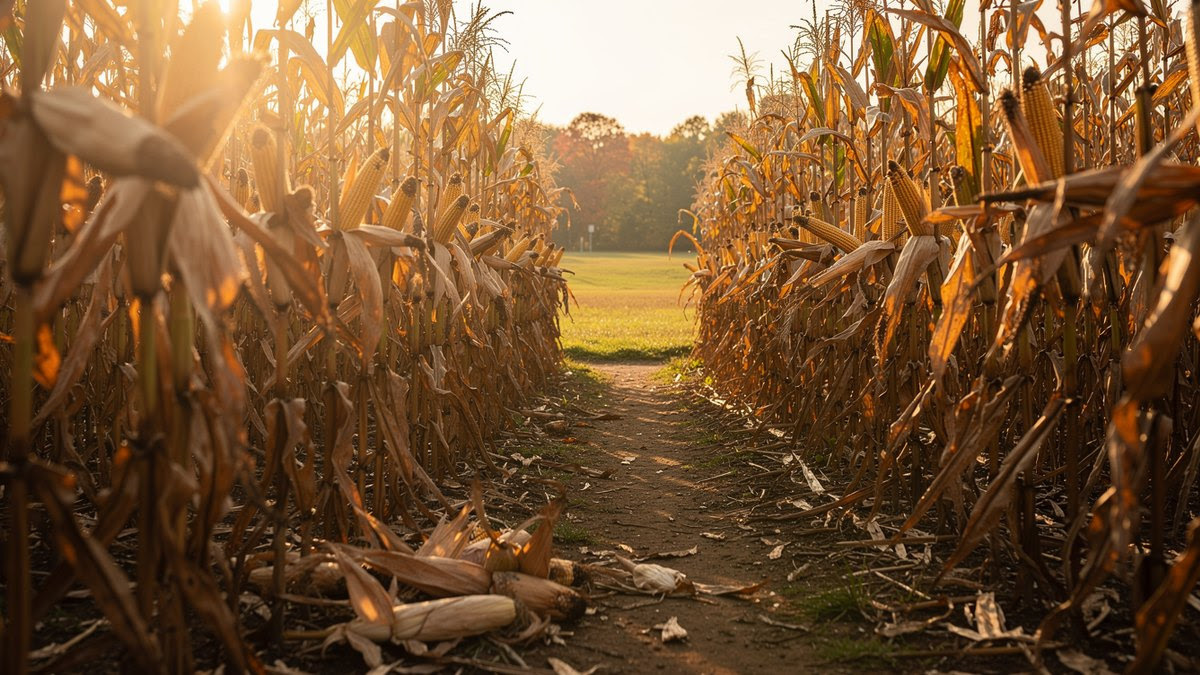
Denver Downs Farm Anderson SC is a family-run fall tradition on Denver Road. Inside the corn maze, the short season, and a whole year of work behind it.
There is a stretch of Denver Road where you can tell what time of year it is without checking a calendar. The air cools off just enough that a flannel makes sense after sundown, the light goes gold earlier every evening, and the traffic picks up in a way it simply does not in June. Denver Downs Farm Anderson SC has become one of those places that marks the season for people here, the same way the first Clemson home game or the first morning you need a jacket at Lake Hartwell does. Families drive out, park in a field, and spend an afternoon doing things that have nothing to do with screens.
What interests us at The Bleckley Blog is not just the fall fun, though there is plenty of that. It is the business underneath it. A working farm that opens its gates to the public for a few weeks every autumn is running a seasonal operation with a very short window and a very long off-season. That takes planning, equipment, and a lot of places to put things. Let's take a look.
Denver Downs sits at 1515 Denver Rd, Anderson, SC 29625, which puts it within easy reach of just about everyone in the county. Folks coming from Boulevard or North Anderson get there in a few minutes. People driving down from Pendleton or Clemson make it part of an afternoon loop. And because Anderson sits where it does, with Clemson University about twenty-five minutes up the road, the farm pulls in a crowd that stretches well past the Anderson County line on fall weekends. There is also a second Denver Downs location, the Farmstead, over at 4915 Clemson Blvd on the other side of town.
Anderson has no shortage of ways to recognize fall. The weather does most of the work, honestly. But a farm that opens up to the public gives the season somewhere to go. Instead of fall being a feeling, it becomes a plan: pick a Saturday, round up the kids or the cousins or the neighbors, and drive out to a field. That shift from feeling to plan is a big part of why these places matter to a community. They give the calendar a shape, and they give people who have not seen each other since summer a reason to stand around in the same field for a few hours.
It is worth remembering what Anderson County looked like before shopping centers and interstate exits. This was farmland and mill country, and the rhythm of life followed what the ground was doing. A good deal of that is gone now, replaced by subdivisions and distribution centers and the kind of employers that keep the Electric City humming. A working farm that invites the public in is one of the few remaining places where a kid from a cul-de-sac can stand in an actual field and understand that food does not originate at a grocery store.
The Denver Downs corn maze is the centerpiece, and it is worth understanding how a thing like that actually comes together, because it is far more deliberate than most visitors realize.
A corn maze is not carved out of a field in October. It starts in the spring, when the corn goes in the ground. The design has to be planned before planting, because the paths are cut while the stalks are still young and manageable, not after they have shot up over your head. Growers typically work from an overhead design, often plotted on a grid, and then walk the field cutting paths that only make sense when you are looking straight down at them. By the time visitors show up in the fall, the corn is tall enough that nobody inside can see the shape at all. That is the trick of it. You are standing inside a drawing you cannot see.
Then comes the part nobody plans for: weather. A corn maze is a crop first and an attraction second. Too much rain at the wrong point in the summer, not enough at another, a wind event that lays a section down flat, and suddenly the design cut back in the spring does not look the way anybody intended in October. Farmers who do this well are managing a living thing on a deadline, which is a very different job from managing a building.
From the visitor side, the appeal is simple. A maze is one of the only attractions where getting lost is the entire point. Phones get put away because there is nothing to photograph but corn. Kids run ahead and double back. Somebody in the group swears they have been down this row already. Teenagers who would not be caught dead enjoying a family outing end up arguing enthusiastically about which direction is north. It works on people of every age because it asks something of you.
Here is the thing that gets overlooked about a business like this: the season is short, and the year is not.
A farm that opens to the public in the fall is building toward that window for months. Fields have to be planted and tended. Parking areas have to be mowed and marked. Signage, fencing, lighting, and barriers all come out of wherever they spent the winter and get inspected, repaired, and set up. Wagons and trailers need maintenance. Anything with a motor needs to actually start on the first cool Saturday in October, not on the third try in November.
And then there is the volume problem. A seasonal operation accumulates an enormous amount of physical stuff that is useless most of the year and absolutely essential for the rest of it. Decorations. Bins and crates. Hay. Ticket booths and folding tables. Fencing panels. Bales, props, and all the small infrastructure that turns a working field into a place people can walk through safely. None of that disappears in January. It has to live somewhere dry and secure until the cycle starts again.
That is the hidden economics of seasonal business in Anderson County. The revenue arrives in a narrow window, but the costs spread across the whole year: storage, maintenance, planning, labor. It is why running a fall attraction is genuinely difficult and why the families who pull it off tend to have deep roots and a lot of practice. You cannot improvise your way into a smooth October. You either spent the spring and summer getting ready or you did not.
Anderson's identity has shifted more than once. We were farmland, then a textile hub with mills running day and night, and many of those old mill buildings are still standing around town, repurposed or waiting to be. We became the Electric City because we were among the first in the Southeast to light up back in 1895. Today the big names on the employment rolls are Bosch, Michelin, AnMed Health, and Anderson County government, and that is a good and stable thing for a city of this size.
But a community is not only its largest employers. It is also the places that give people a reason to gather. The Jockey Lot, one of the largest flea markets in the South, turns a weekend morning into an event. Soiree on the Square fills downtown around that beautiful old courthouse. Green Pond Landing brings anglers and boaters to Lake Hartwell and its roughly 962 miles of shoreline. And out on Denver Road, a farm turns a field into a fall tradition.
What these have in common is that they are not interchangeable. You cannot pick one up and set it down in another town and have it mean the same thing. Fall festivals in Anderson SC work because they are tied to this particular ground, this particular weather, these particular families who decided to keep farming when it would have been simpler to sell.
There is also something quietly valuable in watching a family business operate in public. Kids who visit a farm in October are seeing work, not just entertainment. Somebody planted that corn. Somebody mowed that parking field at six in the morning. Anderson University, with roughly 3,400 students, and the Clemson crowd just up the road keep a steady stream of young adults in this area, and plenty of them end up working seasonal jobs at operations like this. That is how a local economy actually reproduces itself, not through announcements, but through people learning what it takes to run something.
The storage challenge a seasonal farm faces is the same one most Anderson households face, just scaled up. You have a category of belongings that matter intensely for a few weeks and then sit in the way for the rest of the year. For a farm it is maze infrastructure, decorations, and equipment. For a family on the Boulevard or out toward Pendleton, it is the inflatable yard decorations, the stacked bins of holiday lights, the patio furniture that has to come in, the lake gear that goes quiet once Hartwell cools off, and the lawn equipment that trades places with the leaf blower every few months. The garage absorbs all of it until it cannot, and then the car lives in the driveway.
A storage unit breaks that cycle by giving the off-season things a real address. Our 10x10 units run $75 a month and handle seasonal decor, patio sets, and sports and lake gear comfortably. The 10x20 units are $120 a month and are sized for bigger loads, including equipment, inventory for a small seasonal business, or the contents of a barn you are trying to clear out before planting. With 24/7 access and 24/7 security surveillance, you can swap things out at whatever hour fits your schedule, which matters when the work happens before sunrise or after the gates close.
So go get lost in the corn this fall. Drive out Denver Road on a cool Saturday, let the kids run ahead, and appreciate that somebody spent most of a year getting that field ready for your afternoon. And if your own seasonal pile has outgrown the garage, we can help with that part. Your first month is free with a refundable deposit. Call us at (864) 351-4023 or stop by 401 Bleckley St, Anderson, SC 29625, and we will walk you through which size fits what you are storing, so the only maze you deal with this October is the one made of corn.
Frequently asked questions |
Where is Denver Downs Farm in Anderson SC? Denver Downs is located at 1515 Denver Rd, Anderson, SC 29625. There is also a second location, Denver Downs Farmstead, at 4915 Clemson Blvd in Anderson. Check the farm directly for current hours, pricing, and which attractions are open on a given day, since a seasonal farm's schedule depends heavily on the weather. |
How is a corn maze actually made? The design is planned before planting, usually plotted on an overhead grid. The corn goes in the ground in the spring, and the paths are cut while the stalks are still short enough to manage. By fall, the corn is tall enough that visitors inside the maze cannot see the shape at all. Weather through the summer can change how the finished maze looks, since it is a living crop first and an attraction second. |
What else is there to do in Anderson County in the fall? Fall in Anderson County gives you a lot of options beyond the farm. Downtown events around the historic Anderson County Courthouse, the Jockey Lot flea market, Lake Hartwell and Green Pond Landing, and day trips over to Pendleton or Clemson all get better once the heat breaks. The cooler months are when a lot of people rediscover how much there is to do outdoors here. |
What size storage unit do I need for holiday and seasonal decorations? For most families, a 10x10 unit at $75 a month handles holiday decor bins, patio furniture, lake and sports gear, and off-season lawn equipment with room to move around. If you are also storing larger items, business inventory, or clearing out a barn or workshop, the 10x20 unit at $120 a month gives you considerably more space. |
Can I get into my storage unit early in the morning or late at night? Yes. Bleckley Street Self Storage offers 24/7 access along with 24/7 security surveillance, so you can swap out seasonal items whenever your schedule allows. The first month is free with a refundable deposit. Call (864) 351-4023 or visit 401 Bleckley St, Anderson, SC 29625 for details. |