
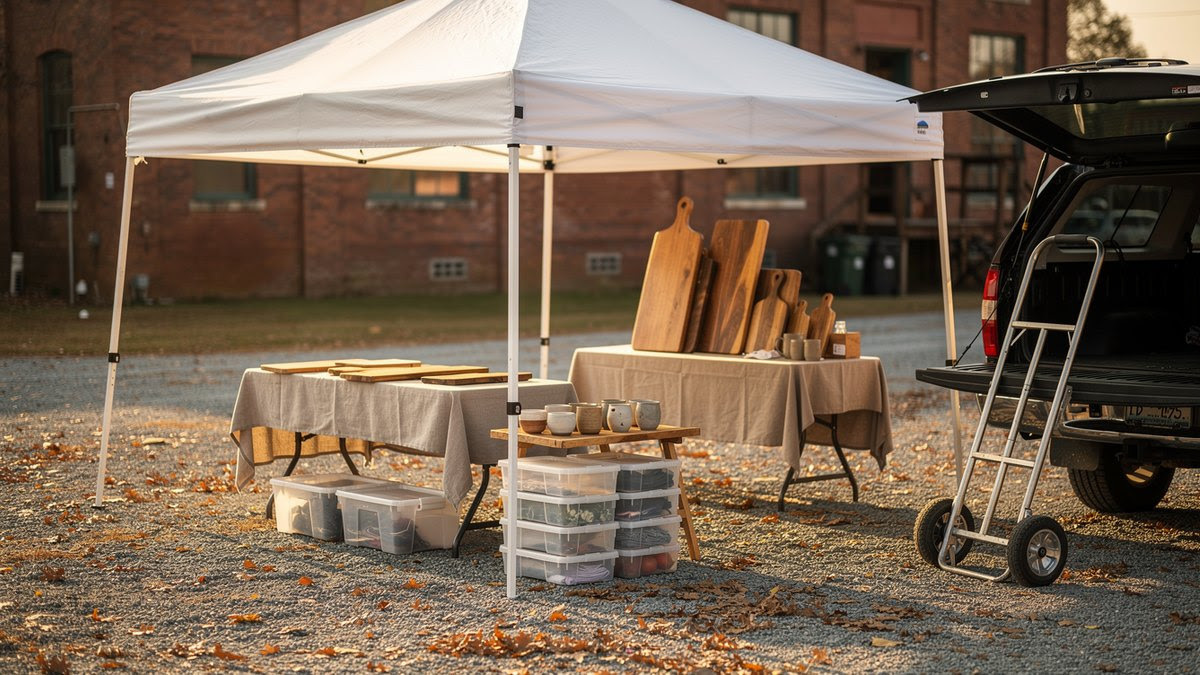
Your guide to fall craft fairs Anderson SC shoppers love: where local makers sell, which vendor markets to visit, and how Anderson makers store their gear.
There is a particular sound that means autumn has arrived in the Electric City, and it is not football. It is the rattle of a folding table being snapped open on a gravel lot at seven in the morning, followed by the zip of a canopy bag and somebody's cooler lid thumping shut. The fall craft fairs Anderson SC shoppers wait all year for start filling up the calendar about the time the mornings turn sharp enough for a flannel, and they keep coming until the last holiday market packs out in December.
This is the season when the people who make things in Anderson County finally come out from behind their workbenches. The woodworker who spends July in a hot garage shaping cutting boards. The soap maker curing bars on a rack in a spare bedroom. The retired teacher who quilts. The young couple roasting coffee in a rented commercial kitchen. For most of the year they sell online, quietly, one box at a time. In the fall they set up a booth, look customers in the eye, and find out what people actually want.
Spring markets are hopeful. Summer markets are sweaty. Fall markets are where the real conversations happen, and any vendor who has worked a full season will tell you the same thing without being asked twice.
Part of it is simple weather math. Anderson in October gives you something close to ideal booth conditions — cool enough that candles do not slump, dry enough that paper goods and prints stay crisp, warm enough that shoppers linger instead of making one lap and bolting for the car. A booth that sits quiet on a muggy June Saturday can stay busy all afternoon once the air changes.
The other part is intent. People shopping a fall market are not browsing. They are buying gifts, and they have specific people in mind. That shifts the whole dynamic. A maker who spent the summer answering "these are cute" now hears "my sister would love this, do you have it in green?" It is the difference between being admired and being in business.
There is also something about the crowd itself. Fall markets in Anderson pull a genuine cross-section — Clemson students home for a weekend, Anderson University families in for a game, folks from Pendleton and Belton who drove in because somebody posted a photo of the pottery booth. You hear people recognizing each other across the aisles. It is a town event that happens to involve commerce.
If you are new to the circuit, or you have lived here for years and somehow never gone, here is where to point the car.
Each one draws a slightly different shopper, which is exactly why serious vendors work more than one. Dates and hours shift from year to year, so check each market's own page before you load the car.
Anderson sits in a sweet spot. Within an easy drive you can hit markets in several counties without ever getting on a long stretch of interstate, and the Upstate's old mill towns have turned out to be natural homes for maker markets.
The Market at the Mill, at 225 Pumpkintown Hwy in Pickens, is the one Anderson folks mention most often when the conversation turns to day trips. The drive up through the foothills is half the reason to go, especially once the color starts turning along the ridgelines. Farther up the road, The Makers Market at 15 Mill St in Inman has built a reputation for handmade work in a town most people only know as a highway exit.
There is a pattern worth noticing here. Mill Street in Inman, a mill site in Pickens, and here in Anderson the old textile buildings scattered through town that have found second lives as studios, shops, and event spaces. Anderson was a textile hub for generations, and those brick shells were built for making things. It is fitting that they have circled back around to housing people who make things, just at a different scale.
For a maker, working the wider Upstate circuit is how you figure out your product. A line that moves slowly in one town can sell out in the next. The Pickens crowd and the Anderson crowd and the Inman crowd are not the same people, and the only way to learn what each one responds to is to pack the van and go find out.
Shopping a market well is a small skill, and it makes the day better for you and for the vendors.
And if you are thinking about becoming a vendor rather than a shopper, the entry point is lower than most people assume. A canopy, two folding tables, a tablecloth that reaches the ground, and enough inventory to look intentional will get you through your first season. The hard part is not the setup. The hard part is doing it weekend after weekend through the whole season, and then figuring out where to put all of it come Monday morning.
That Monday morning problem is real, and it is the quiet reason a lot of promising side businesses stall out. A ten-by-ten canopy, weights, two six-foot tables, grid walls or shelving, bins of inventory, signage, a dolly, and the tubs of packing material add up fast. Stacked in a garage, it means nobody parks inside until January. Stacked in a spare bedroom, it means the house slowly turns into a warehouse with a bed in it. A hot, uninsulated backyard shed is not much better for candles, finished wood, or folded textiles that need to come out looking like new.
A storage unit solves that in a straightforward way. Our 10x10 at $75 a month holds a full booth kit plus inventory for most makers, with room to walk in and pull what you need. The 10x20 at $120 a month gives you enough floor to actually stage — shelving along one wall, your booth layout built out, restock bins sorted and labeled by market date. Round-the-clock access matters more than people expect when your load-out is a 5 a.m. Saturday and your unload is 9 p.m. the same night, and 24/7 security surveillance matters when the unit holds a season's worth of work. The first month is free with a refundable deposit, which is a fair way to test whether the setup fits how you work.
Fall craft fair season in Anderson is short, intense, and genuinely rewarding for the makers who take it seriously. The ones who last tend to be the ones who got organized — who stopped losing an hour before every market hunting for the tent weights, and who could tell at a glance what was left of the inventory. Go spend a Saturday walking a market this season, ask somebody how they made the thing in your hands, and buy it from them directly. If you are on the vendor side and the gear has outgrown the garage, we are at 401 Bleckley St, Anderson, SC 29625, and you can reach us at (864) 351-4023.
FREQUENTLY ASKED QUESTIONS |
When does craft fair season start in Anderson SC? Market activity picks up around Anderson County once the weather cools in the fall and runs through the holiday season, closing out with indoor holiday markets like the Holly Jolly Holiday Fair at the Civic Center of Anderson. Because dates shift year to year, check each market's own page for its current schedule before you go. |
Where can I find handmade goods from local makers in Anderson SC? Anderson Makers Market on E Greenville St, the Anderson County Farmers Market on N Murray Ave, and the Anderson Arts Center on Federal St are all good starting points. For a wider Upstate SC trip, The Market at the Mill in Pickens and The Makers Market in Inman are both within an easy drive. |
What do I need to sell at a vendor market in Anderson? Most first-time vendors start with a 10x10 canopy, canopy weights, two folding tables, floor-length tablecloths, clear signage, a dolly, and enough inventory to make the booth look intentional. A card reader and a cash box round it out. Individual markets set their own application and fee requirements, so contact the organizer directly. |
What size storage unit does a craft fair vendor need? A 10x10 unit at $75 a month fits a full booth kit — canopy, tables, display shelving, signage — plus inventory bins for most makers. A 10x20 at $120 a month gives you room to stage a booth layout, run shelving along a wall, and sort restock by market date without moving everything twice. |
Can I get into my storage unit early in the morning for a market setup? Yes. Bleckley Street Self Storage offers 24/7 access along with 24/7 security surveillance, so a pre-dawn Saturday load-out and a late-night unload both work. The facility is at 401 Bleckley St in Anderson, and the first month is free with a refundable deposit. |