
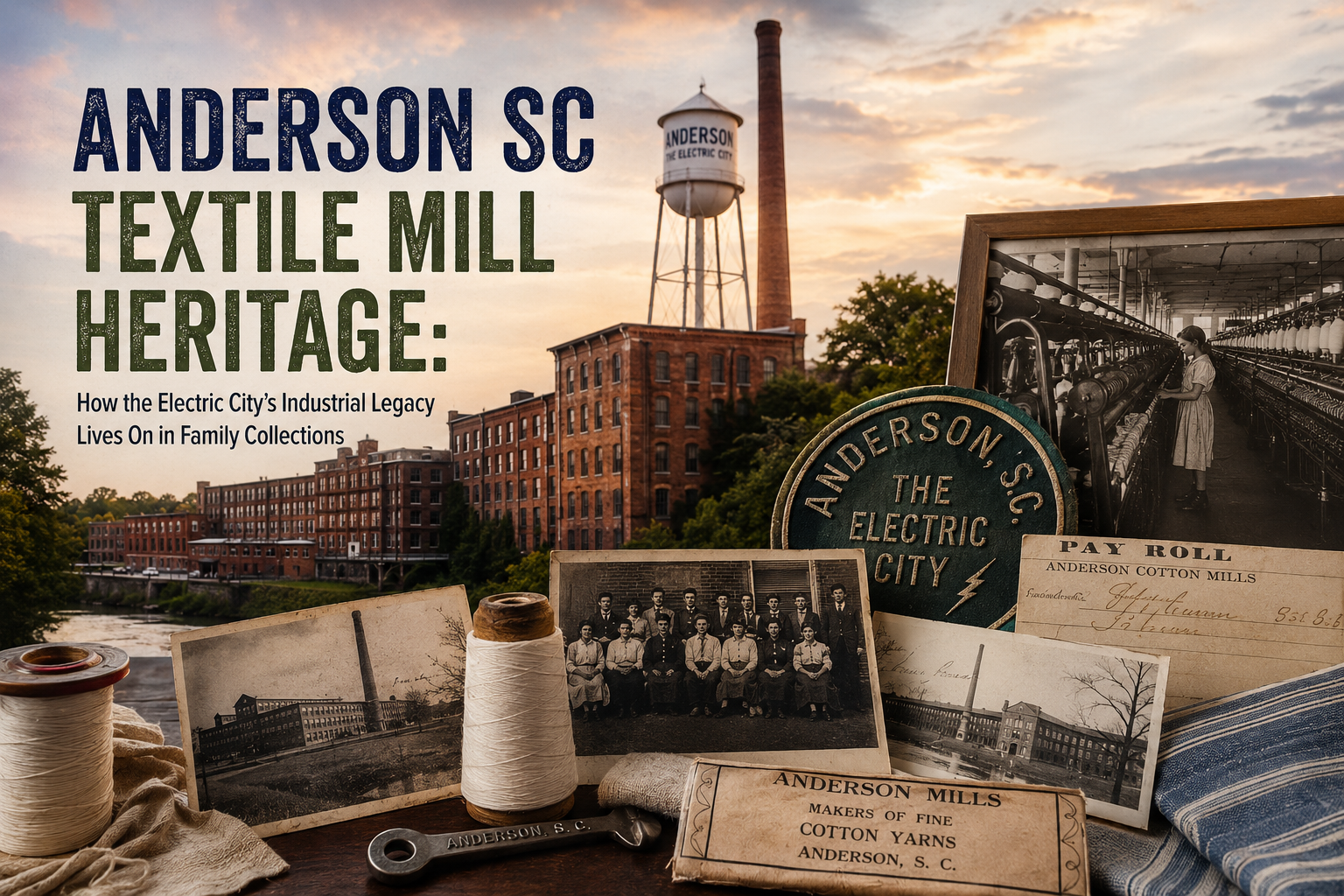
Walk through any older neighborhood in Anderson, and you'll find homes where mill worker families built their American dreams. From Boulevard to North Anderson, generations of families still hold onto pieces of the Electric City's textile legacy—faded company ID badges, work uniforms bearing mill logos, and photographs of proud workers standing before massive looms. These aren't just collectibles; they're tangible connections to the industrial heritage that shaped Anderson SC textile mill heritage and made our community what it is today.
While Anderson's mills have largely fallen silent, the stories live on in family attics, closets, and memory boxes. These collections tell the real story of how electricity transformed a small Southern town into a bustling industrial center, one family at a time.
Anderson's transformation into a textile powerhouse didn't happen overnight. When electricity came to the Electric City in 1895—making it the first city in the Southeast to harness this new power—mill owners saw an opportunity that would reshape the entire region. The abundant water power from nearby rivers, combined with this revolutionary electrical system, created perfect conditions for textile manufacturing.
By the early 1900s, Anderson County hosted dozens of textile operations. Mills like Anderson Cotton Mills, Equinox Mills, and Toxaway Mills became household names, employing thousands of families and creating entire communities around their operations. The sound of spinning machinery became the heartbeat of the Electric City, running three shifts a day to meet growing demand.
These weren't just factories—they were the foundation of Anderson's economy and social structure. Mill villages sprouted around major operations, complete with company stores, schools, and recreational facilities. Families often worked together, with children following parents into the mills as soon as they came of age.
The daily rhythm of mill life created a unique culture that many Anderson families still remember through stories passed down from grandparents and great-grandparents. Workers started their shifts before dawn, walking to nearby mills through neighborhoods that buzzed with activity at all hours.
Mill villages had their own character and tight-knit communities. Families in Homeland Park, for example, lived just steps from the mills where they worked. Company housing, while modest, provided stability for working families during an era when such security was rare. Children played in mill village streets while their parents worked shifts that kept Anderson's textile economy running around the clock.
The mills also fostered innovation and skill development. Many Anderson workers became experts in textile machinery, quality control, and production management. These skills often stayed in families for generations, with sons and daughters learning the trade from their parents and carrying forward both practical knowledge and deep pride in their craftsmanship.
Today's Anderson families are the keepers of this rich textile heritage. Many still have boxes of memorabilia that paint vivid pictures of mill life—company newsletters announcing new contracts, group photos of entire shifts, even fragments of fabric samples that showcase the quality Anderson mills were known for producing.
These family collections often include items that seem simple but carry profound meaning. A time clock punch card from 1952 tells the story of perfect attendance. A union pin represents solidarity during challenging times. A retirement watch celebrates decades of dedicated service. Together, these objects create a mosaic of working-class life in the Electric City.
Some families have preserved entire uniforms, still bearing the smell of cotton and machinery oil. Others hold onto handwritten notes and personal letters that mill workers exchanged during breaks, revealing the human side of industrial work. These personal artifacts make Anderson's textile history feel immediate and real, connecting today's residents to their industrial roots.
While most of Anderson's original textile operations have closed or moved overseas, their influence remains visible throughout the community. Several historic mill buildings have been repurposed for modern businesses, maintaining their architectural character while serving new functions. The old mill villages still exist as distinct neighborhoods, each with its own personality shaped by decades of textile industry life.
Local historical societies and family historians work to document these stories before they're lost. The Anderson County Museum maintains extensive textile heritage exhibits, but much of the most meaningful preservation happens in family homes, where personal collections keep individual stories alive.
Some Anderson families have turned their textile heritage into educational opportunities, sharing artifacts with local schools or participating in community history events. These efforts ensure that younger generations understand how the mills shaped not just Anderson's economy, but its character and values.
Many Anderson families find themselves inheriting significant collections of textile mill memorabilia from parents and grandparents. These inherited treasures often include everything from work uniforms and company documents to family photographs and industrial artifacts. While these items hold immense sentimental value, they can quickly overwhelm living spaces, especially when combined with other family heirlooms and seasonal belongings.
A storage unit provides an ideal solution for preserving these important family collections while keeping your home organized. At Bleckley Street Self Storage, our 10x10 and 10x20 units offer secure, accessible space for textile heritage items that deserve better than cramped attic storage. You can organize these collections properly, protect them from humidity and temperature fluctuations, and still have easy access when you want to share family history with children or grandchildren. With 24/7 access and security surveillance, you can visit your family's textile legacy whenever the mood strikes, whether you're researching family history or preparing for a community heritage event.
What textile mills operated in Anderson SC historically?
Major Anderson textile operations included Anderson Cotton Mills, Equinox Mills, Toxaway Mills, and several smaller facilities. Most operated from the early 1900s through the 1980s, taking advantage of Anderson's electrical infrastructure and water power.
Where can I research my family's textile mill heritage in Anderson?
The Anderson County Museum maintains textile industry exhibits and archives. The Anderson County Library also has historical resources, and local genealogy groups often share mill worker family stories and records.
Are there any original mill buildings still standing in Anderson?
Yes, several historic mill buildings remain throughout Anderson, though most have been repurposed for modern businesses. Some retain their original architectural character and serve as landmarks of the city's industrial heritage.
What should I do with inherited textile mill memorabilia and family collections?
These items deserve proper preservation. Consider organizing them in acid-free containers and storing them in a secure, accessible location. Many families use storage units to protect these collections while keeping their homes uncluttered.
How much storage space do I need for family heritage collections?
It depends on the size of your collection, but most family heritage items fit comfortably in a 10x10 unit. Larger collections with furniture or industrial artifacts might benefit from a 10x20 space for better organization and access.
Anderson's textile mill heritage lives on in the personal collections that families have preserved across generations. These tangible pieces of history—from work uniforms to company photographs—tell the human story behind the Electric City's industrial transformation. By properly preserving and sharing these family treasures, Anderson residents ensure that future generations will understand the pride, hard work, and community spirit that defined mill worker families and shaped our city's character. Contact Bleckley Street Self Storage at (864) 351-4023 to discuss secure storage solutions for your family's textile heritage collection.