
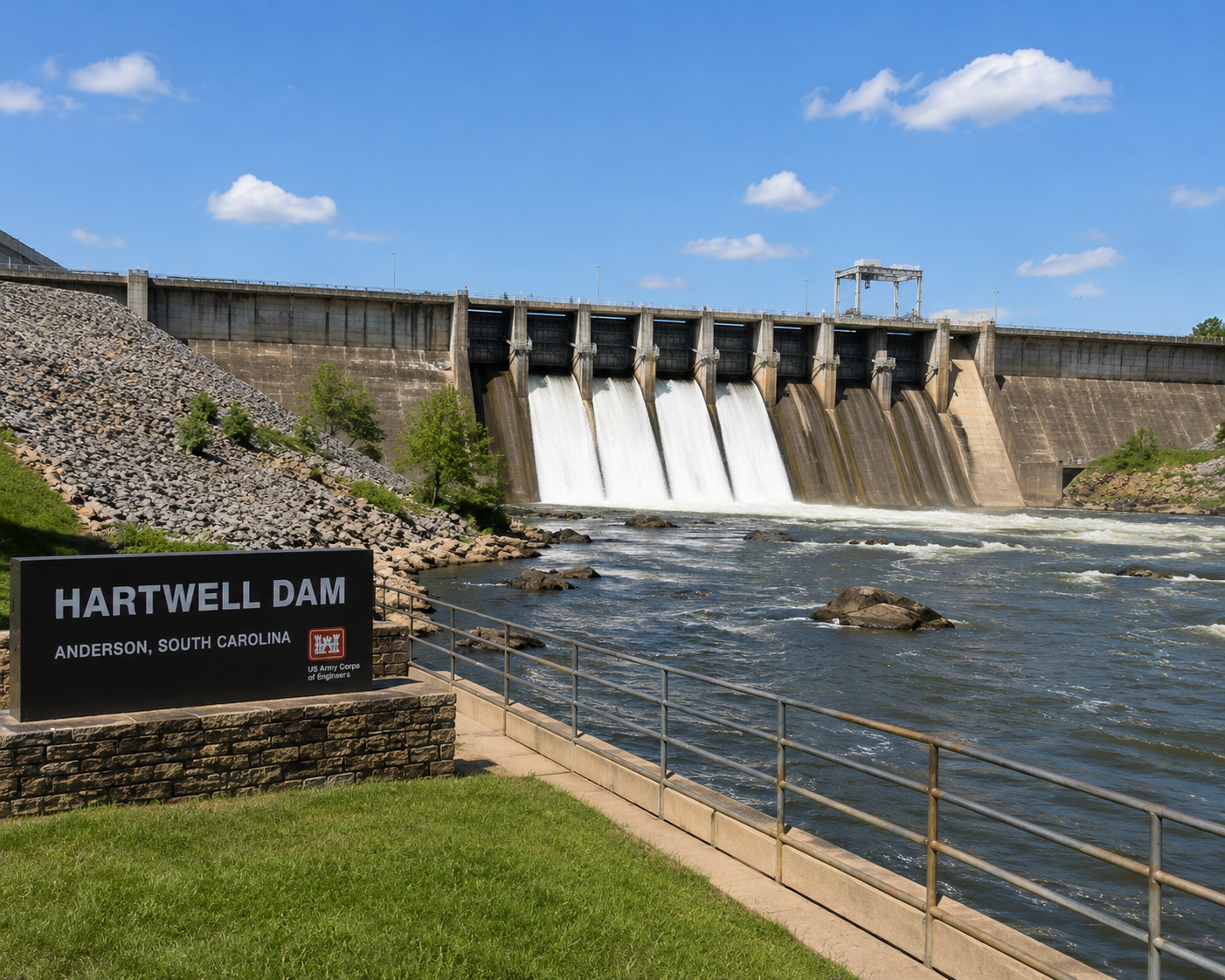
Before Anderson County families were skiing behind boats or casting lines from their docks on Lake Hartwell, this land told a different story. Where water now laps against marina piers and vacation homes, entire communities once thrived along the Tugaloo and Seneca Rivers. The Anderson SC Lake Hartwell dam construction project, spanning from 1955 to 1963, stands as one of the most transformative engineering feats in Electric City history—a massive undertaking that forever changed the landscape, displaced thousands of residents, and created the recreational paradise we know today.
This wasn't just about building a dam. The Lake Hartwell project represented a complete reimagining of how Anderson County residents would live, work, and play for generations to come. The U.S. Army Corps of Engineers didn't just move earth and concrete; they moved entire communities, relocated cemeteries, and submerged a way of life that had existed since the early 1800s.
The Lake Hartwell dam project emerged from post-World War II America's ambitious infrastructure boom. The U.S. Army Corps of Engineers identified the confluence of the Tugaloo and Seneca Rivers as an ideal location for flood control, hydroelectric power generation, and recreational development. For Anderson County, already known as the Electric City since 1895, this project promised to cement the region's reputation as a forward-thinking community.
Planning began in earnest during the early 1950s. Engineers surveyed thousands of acres across Anderson County and northeast Georgia, mapping out what would become a 56,000-acre lake with 962 miles of shoreline. The proposed dam would stretch 2,415 feet across and rise 204 feet above the riverbed—a concrete giant that would control water flow for three states.
The economic implications were staggering. The project would bring hundreds of construction jobs to Anderson County, establish the region as a recreational destination, and provide reliable flood control for communities downstream. For a county still recovering from the decline of textile manufacturing, the timing couldn't have been better.
Construction of the Lake Hartwell dam presented unique engineering challenges that pushed 1950s technology to its limits. The Corps of Engineers had to divert two major rivers while building a structure designed to withstand everything from earthquake tremors to hundred-year floods. The location—where the Tugaloo and Seneca Rivers meet—required innovative solutions for managing water flow during the eight-year construction period.
Workers poured over 1.2 million cubic yards of concrete, creating a structure weighing more than 2.5 million tons. The dam's powerhouse was designed to house four massive turbines, each capable of generating 34,000 kilowatts of electricity. For Anderson County, already proud of its electrical heritage, this represented a continuation of the innovative spirit that earned the Electric City its nickname.
The construction process required round-the-clock operations. Concrete pours couldn't be interrupted, meaning workers often labored through Anderson's humid summer nights and occasional winter freezes. Specialized equipment had to be transported along rural Anderson County roads that were never designed for such heavy machinery.
Perhaps the most challenging aspect of the Lake Hartwell dam construction wasn't engineering—it was human. The project required relocating approximately 5,000 people from Anderson County and northeast Georgia. Entire communities that had existed for generations would disappear beneath the rising waters.
In Anderson County alone, the project affected established neighborhoods, family farms that had operated since the 1800s, and small businesses that served rural communities. The Corps of Engineers worked with local officials to identify suitable relocation sites, often purchasing land on higher ground where displaced families could rebuild their lives.
Some of Anderson County's most historic sites were lost forever. Old churches, one-room schoolhouses, and family cemeteries had to be relocated or carefully documented before the waters rose. The emotional toll on longtime residents was immense—many families had lived in the same communities since their ancestors first settled Anderson County in the early 1800s.
The relocation process revealed the strong community bonds that characterized Anderson County. Neighbors helped neighbors pack belongings, transport livestock, and rebuild homes on higher ground. Local churches coordinated relief efforts, and Anderson businesses donated supplies for families starting over.
The Lake Hartwell project officially broke ground on July 2, 1955, with a ceremony attended by Anderson County officials, Corps of Engineers leadership, and hundreds of local residents. The first phase involved massive earthmoving operations—clearing timber, removing topsoil, and excavating the foundation for what would become one of the Southeast's largest concrete dams.
By 1957, the concrete pours began in earnest. Anderson County residents could drive out to witness the growing structure that would reshape their region's future. Local newspapers regularly reported construction progress, and the dam site became an informal tourist attraction for Electric City families curious about this massive undertaking.
The dam's completion in 1962 marked a historic moment for Anderson County. Water began backing up behind the concrete structure, slowly filling what would become Lake Hartwell. The process took nearly two years as engineers carefully monitored water levels and structural integrity.
Power generation began on March 15, 1963, when the first turbine came online. For Anderson, already the Electric City, this represented a full-circle moment—the community that pioneered electrical service in the Southeast was now generating power for the regional grid.
As Lake Hartwell filled during 1962 and 1963, Anderson County residents witnessed their familiar landscape transforming into something entirely new. Rolling farmland disappeared beneath expanding waters, while new shorelines emerged where hills met the rising lake surface. Roads that had connected Anderson County communities for decades simply vanished underwater.
The lake's creation established Anderson County as a recreational destination. What had been primarily agricultural and textile-focused communities suddenly found themselves sitting on valuable lakefront property. Families who had reluctantly relocated due to the dam construction discovered that their new higher-ground properties offered stunning lake views and recreational opportunities their grandparents never could have imagined.
Anderson County's economy began shifting toward tourism and recreation. Marinas appeared along the new shoreline, and boat dealers set up shop in Anderson to serve the growing community of lake enthusiasts. The transformation was so complete that visitors today struggle to imagine Anderson County without Lake Hartwell's defining presence.
The massive relocation effort that accompanied Anderson SC Lake Hartwell dam construction created one of the largest residential moves in Electric City history. Between 1955 and 1963, thousands of Anderson County families packed up entire households—some containing generations of accumulated belongings—and relocated to higher ground. This displacement created an unprecedented need for temporary storage as families sorted through possessions, decided what to keep, and waited for new homes to be completed.
Many Anderson families turned to temporary storage solutions during this transitional period, keeping family heirlooms, vintage furniture, and important documents safe while they rebuilt their lives. Today, decades later, many of these same families continue storing pieces of pre-dam Anderson County history. At Bleckley Street Self Storage, we regularly help Anderson residents preserve everything from vintage photographs documenting communities now underwater to antique furniture passed down from families who once farmed the land beneath Lake Hartwell. Our 10x10 and 10x20 units provide secure, accessible storage for these irreplaceable connections to Anderson's pre-lake heritage, ensuring that future generations can understand what came before the waters rose.