
Learn how to pack a storage unit like a pro with Anderson SC storage tips: smart stacking, labeling, aisle space, and furniture protection that
Late summer in Anderson has a rhythm you can feel. Traffic thickens on the highways, campus sidewalks fill back up, houses out toward the water start swapping tubes and towels for closed-up porches, and half the families on our street seem to be shuffling furniture between a garage, a truck, and somebody's spare bedroom. It's the season of stuff in motion. And if you've ever stood at the door of a rented unit with a loaded trailer behind you and no plan, you already know why learning how to pack a storage unit properly is worth an hour of thinking before you lift a single box.
Good packing is not about cramming. It's about geometry, weight, and future-you. A well-packed unit gives you back square footage you already paid for, keeps your dining table from getting scarred, and lets you walk in on a rainy October Saturday and pull out the one bin you actually need. A badly packed unit becomes a wall of cardboard you dread opening. This guide walks through the whole process the practical way: unfussy, straightforward, and built for how people around Anderson County actually move.
The single biggest mistake people make is treating a storage unit like a closet and just filling it front to back in whatever order the truck was loaded. A storage unit is more like a shipping container. It has a floor plan, a ceiling, and a door, and every one of those matters.
Start with a rough inventory. You don't need a spreadsheet, though a notes app on your phone works fine. Walk your house or apartment and group items into three piles in your head: things you will not need until you move again, things you may want to grab in a month or two, and things that are awkward or fragile enough to need special handling. That third group is usually smaller than people expect, and identifying it early keeps you from stacking a box of dishes under a box of hand weights.
Then sketch the unit. Seriously, a rectangle on paper beats guessing. A 10x10 holds the contents of a modest apartment or a couple of bedrooms plus boxes. A 10x20 is closer to a full house, or a household plus a motorcycle, kayaks, or lawn equipment. Decide before loading day where the big furniture goes, where the box wall goes, and where your walkway runs. When you have a plan, the truck gets unloaded in the right order instead of the random order.
One more planning step people skip: check the dimensions of your largest single item. Sectional sofas, chest freezers, and long dining tables are the pieces that decide your layout. Everything else fits around them.
Uniform boxes are the closest thing to a cheat code in this whole process. Mismatched grocery store boxes, banker's boxes, and diaper boxes create a stack that wobbles, collapses, and wastes air. Boxes of consistent sizes stack like bricks and let you build straight to the ceiling.
A few rules that hold up every time:
Wardrobe boxes are the one specialty item worth the extra cost if you have hanging clothes. Suits, dresses, and coats survive far better on a bar than folded into a bin for a year. For a student downsizing out of a dorm or a nearby rental, a single wardrobe box often replaces three sloppy trash bags.
Think in layers, back to front, heavy to light. Your unit should be loaded like a well-packed dishwasher, not a landfill.
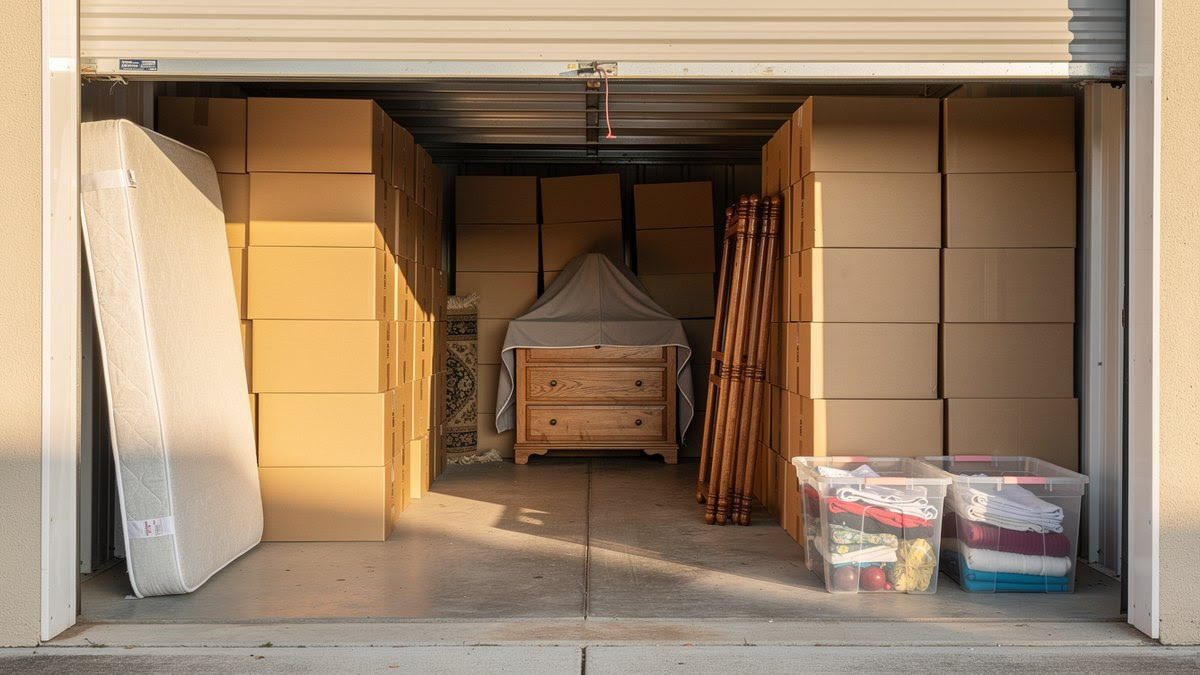
Start with the biggest, heaviest, least-needed items along the back wall. Appliances, dressers, headboards, box springs, and bookcases go first. Stand mattresses and box springs on their long edge against a side wall rather than laying them flat, which frees up an enormous amount of floor. Brace them with something solid so they don't bow over time.
Next, build your box walls in front of and beside the furniture. Heaviest boxes on the bottom, medium in the middle, light and fragile on top. Keep the stacks squared up and flush with each other so they support one another rather than leaning.
Furniture that can nest should nest. Remove table legs when they come off easily, tape the hardware in a labeled bag to the underside of the tabletop, and store tabletops vertically against a wall. Chairs can often be stacked seat-to-seat or turned upside down onto a table surface with a blanket in between. Drawers and appliance interiors are free storage: fill dresser drawers with linens, put the pots inside the deep freezer, and tuck small boxes into the washing machine drum.
Save the last few feet nearest the door for the things you know you'll need: holiday decorations, seasonal clothing, boating and camping gear, the toolbox. Those are your "front row" items, and they should never end up buried behind the dining hutch.
Most people rent enough space. They just don't use the top half of it. A unit is a cube, not a floor, and the vertical dimension is where the savings live.
Build upward in columns you can trust. That means a stable base of heavy, well-filled boxes, straight sides, and no pyramid-shaped stacks that taper into instability. If a stack wiggles when you nudge it, take the top box off and re-stack. Nothing ruins a good packing job faster than an avalanche you discover months later.
Use furniture as shelving. The top of a sturdy dresser or a low bookcase becomes a platform for boxes. Turn a bookcase toward the aisle and its shelves become a place for bins and odd-shaped items that don't stack well on their own. Freestanding shelf units, even inexpensive metal ones, pay for themselves in a long-term unit by turning wasted air into usable levels.
Long, thin items are your friends in the gaps. Curtain rods, ladders, rolled rugs, folded tables, mirrors, and framed art slide neatly into the narrow slots between stacks and walls. Wrap mirrors and glass in blankets or moving pads and store them on edge, never flat, where something can be set on top of them.
And leave the ceiling a little breathing room. Don't jam boxes so tight against the top that you have to wrestle them free later, and don't block the light. A unit you can see into is a unit you'll actually use.
Packing for space is one job. Packing for preservation is another, and it's the one people regret skipping.
Wood furniture wants to breathe. Wrap tables, dressers, and chairs in moving blankets, old quilts, or breathable furniture pads rather than sealing them in plastic sheeting, which traps moisture against the finish. Put felt pads or cardboard between any two surfaces that touch, because vibration and pressure over months will leave marks that a single afternoon never would.
Upholstery does better covered but not suffocated. Fabric covers or sheets keep dust off while still allowing airflow. Leather appreciates a conditioner before it goes into long-term storage.
Electronics travel best in their original boxes if you kept them, and in well-padded boxes if you didn't. Coil cables loosely, bag them, and tape the bag to the device it belongs to so you're not sorting a cable nest next spring. Keep screens vertical and store them off the floor. Pull batteries out of remotes, flashlights, and toys before anything goes into a box, because a leaking battery ruins whatever it's sitting in.
A short list of things that simply shouldn't go into a storage unit: anything perishable, anything flammable or under pressure, anything with liquid fuel in the tank, and any container of liquid that could freeze, burst, or seep. Drain the mower, empty the cooler, and take the half-can of paint to a proper disposal site instead.
You will forget. Everyone does. The box that seemed unmistakable in July is anonymous cardboard by February.
Label on at least two sides plus the top, in thick marker, with the room it came from and two or three specific contents. "Kitchen: mixing bowls, small appliances" beats "Kitchen" every time. Number your boxes and keep a running list in your phone if you're storing a full household. Color-coded tape by room is a low-effort trick that pays off during unloading, since you can direct helpers by color instead of reading every label.
Then, and this is the tip most people wish they'd heard first: leave a center aisle. Even a narrow walkway from the door to the back wall transforms your unit from a solid block into something you can navigate. Turn all your labels to face that aisle. Keep frequently needed items along it. If you're storing seasonal things, arrange them so that swapping summer for fall doesn't require unpacking the whole unit.
For a 10x20, a corridor down the middle with stacks on both sides works beautifully. For a 10x10, a single aisle along one side is usually the better use of the footprint.
All the packing skill in the world can't fix a unit that's the wrong size, and this is where a little local advice helps. At Bleckley Street Self Storage, our 10x10 units run $75 a month and suit the classic Anderson situations: a student consolidating a dorm or apartment between semesters, a couple staging a house for sale, or a family clearing out a bonus room. Our 10x20 units are $120 a month and handle whole-house moves, outdoor gear, and business inventory with room left over for that center aisle you'll be glad you kept.
Access matters just as much as square footage. We're at 401 Bleckley St, right in town, with 24/7 access and 24/7 security surveillance, so loading around a work shift or an early-morning trip out to the water is genuinely possible. And because your first month is free with a refundable deposit, there's room in the budget for the shelving unit or the wardrobe boxes that make your packing plan actually work. If you're not sure which size fits your pile, describe it to us. We've watched a lot of Anderson County households come through these doors, and we can usually tell you which door you need.
A storage unit packed with a little forethought is one of the quietest conveniences there is. You walk in, you find the thing, you walk out. No wrestling, no avalanche, no scratched tabletop. A smart floor plan for your own belongings is the kind of small, practical fix that makes the rest of a busy season feel manageable.
If you're heading into a move, a downsizing, or a between-semesters shuffle, give us a call at (864) 351-4023 or come see the units in person at 401 Bleckley St, Anderson, SC 29625. Ask about the first month free with a refundable deposit, and we'll help you pick a size that leaves you room to walk.
Frequently asked questions |
How do you pack a storage unit so you can still get to your stuff? Leave a walkway. Load the heaviest, least-needed furniture along the back wall, build your box stacks along the sides, and keep a clear aisle from the door to the back. Turn every label to face that aisle, and keep seasonal or frequently used items in the front few feet so you never have to unpack the unit to reach one bin. |
What size storage unit do I need for a college move-out in Anderson SC? For a dorm room or a shared apartment's worth of belongings, a 10x10 is usually plenty, especially if you use vertical space and stack uniform boxes. A 10x20 makes more sense if you're storing a full apartment of furniture, a bike or kayaks, and a household's worth of boxes. At Bleckley Street Self Storage, 10x10 units are $75 a month and 10x20 units are $120 a month. Call (864) 351-4023, describe your pile, and we'll help you decide. |
Should I wrap wood furniture in plastic before storing it? It's better to use moving blankets, furniture pads, or old quilts. Plastic sheeting seals moisture against the finish. Breathable coverings keep dust off while letting air move, and slipping cardboard or felt between surfaces that touch prevents pressure marks over a long stay. |
What should never go in a storage unit? Anything perishable, anything flammable or pressurized, gas-powered equipment with fuel still in the tank, and open containers of liquid. Drain the mower, empty coolers, and dispose of paint and chemicals properly. Also pull batteries out of remotes, flashlights, and toys before boxing them, since a leaking battery can ruin everything around it. |
Can I access my storage unit at Bleckley Street Self Storage at night? Yes. We offer 24/7 access along with 24/7 security surveillance, which helps if you're loading around a work shift, heading out early for a day on the water, or getting back late from a trip. We're at 401 Bleckley St, Anderson, SC 29625, and the first month is free with a refundable deposit. |